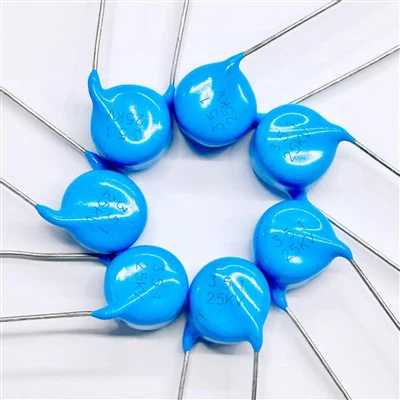
High-voltage ceramic capacitors utilize a ceramic dielectric to store electric charge. Their high voltage-withstanding capability stems from specialized ceramic formulations-such as those based on barium titanate or strontium titanate-as well as a thick-layer dielectric design and optimized manufacturing processes.
During and after the curing of the secondary encapsulation module, mechanical stresses can create voids at the ceramic-epoxy interface. Furthermore, voids within the dielectric itself are primarily caused by organic or inorganic contaminants in the ceramic powder, or by improper control during the sintering process. These defects act as weak points, thereby compromising the capacitor's voltage-withstanding capability.
The ceramic body itself is an inherently brittle material; consequently, significant mechanical stresses encountered during manufacturing and handling can induce stress cracks, leading to a reduction in voltage withstand strength.
In semi-sealed capacitors exposed to high-temperature and high-humidity environments, infiltrating water molecules can trigger electrolytic reactions. This leads to the migration of silver ions and the formation of conductive dendrites, resulting in increased leakage currents or even catastrophic dielectric breakdown (short-circuiting).
Under the influence of an electric field, the breakdown failure of ceramic capacitors typically adheres to the "weak-point breakdown theory," wherein partial discharge serves as the root cause of such localized failure. Breakdown phenomena can be broadly categorized into electrochemical breakdown and surface flashover between electrodes. Electrochemical breakdown is associated with silver ion migration and dielectric reduction reactions, whereas surface flashover typically occurs under conditions of high humidity or electric field distortion.
To mitigate the issue of silver ion migration, the adoption of nickel electrodes-which possess superior chemical stability and lower electromigration rates compared to silver-has significantly enhanced the performance and reliability of ceramic capacitors. Furthermore, optimizing the encapsulation materials can improve performance; specifically, increasing the curing temperature tends to raise the breakdown voltage of high-voltage ceramic capacitors, as high-temperature curing facilitates the rapid and effective reduction of residual internal stresses. Additionally, the breakdown strength can be further enhanced through the development of novel material formulations and precise control over the dielectric layer thickness.