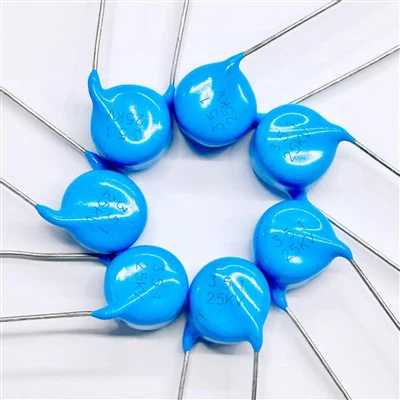
Based on voltage rating, high-voltage ceramic capacitors can be broadly classified into high-voltage, medium-voltage, and low-voltage categories. The ceramic materials used in these capacitors primarily fall into two types: barium titanate-based and strontium titanate-based. Barium titanate-based ceramic materials offer the advantages of a high dielectric constant and excellent AC voltage withstand characteristics; however, they also present certain drawbacks, such as capacitance increasing with rising dielectric temperature and a decrease in insulation resistance. Strontium titanate-based ceramic materials, conversely, exhibit minimal variation in dielectric coefficient, a low dielectric loss tangent (tgδ), and a low rate of capacitance change.
For instance, consider a 40kV, 10,000pF high-voltage ceramic disc capacitor. It may utilize various ceramic materials-such as UJ, SL, X5F(B), X7R(B), N4700(DL), Y5T(D), Y5U(E), and Y5V(F)-each corresponding to specific operating temperature ranges, insulation resistance values, and dielectric loss parameters. Taking the N4700 material as an example: within a temperature range of -25°C to +85°C, it features an insulation resistance of ≥200,000 MΩ, a dielectric loss of ≤0.2%, and a capacitance variation rate of ±28% or ±33%.
Safety-certified products within this category have successfully passed safety standard certifications in various countries-such as X1/440V and Y2/300V-and fully comply with the AEC-Q200 specifications required for passive components in automotive applications.