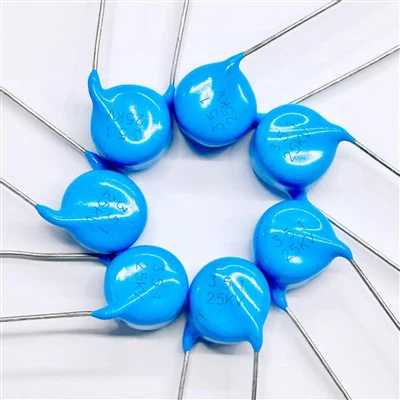
The structure of a high-voltage ceramic capacitor consists of a ceramic dielectric, internal electrodes, and external electrodes. The internal electrode materials typically include silver, copper, or nickel, while the packaging configurations are predominantly disc-shaped, plate-like, or tubular. The ceramic dielectric is fabricated by extruding the material into the form of tubes, plates, or discs.
Traditionally, silver electrodes have been employed; however, silver ion migration can lead to device failure. To enhance reliability, nickel electrodes-which possess superior chemical stability-may be utilized instead. The dielectric materials primarily consist of barium titanate-based and strontium titanate-based ceramics. Recent research has explored the use of dielectric compositions such as Ba(TimZrnSnpCeqSis)O3, achieving improved dielectric breakdown strength by precisely controlling the layer thickness within the range of 5 to 15 mm.
Regarding thermal management, a specific tubular structural design incorporates an inner shell, an outer shell, a heat dissipation chamber, and heat-absorbing tubes wound around the inner shell; this configuration facilitates dual-path thermal conduction to maximize heat dissipation efficiency. In terms of encapsulation optimization, both the thickness and curing temperature of the epoxy encapsulant significantly influence the capacitor's voltage withstand capability. High-temperature curing helps to mitigate residual stresses and prevents the formation of air gaps at the interface between the ceramic dielectric and the epoxy encapsulant. Furthermore, applying a glass glaze coating to the edges of the interface between the electrodes and the dielectric surface constitutes an effective design strategy for enhancing the dielectric breakdown voltage.