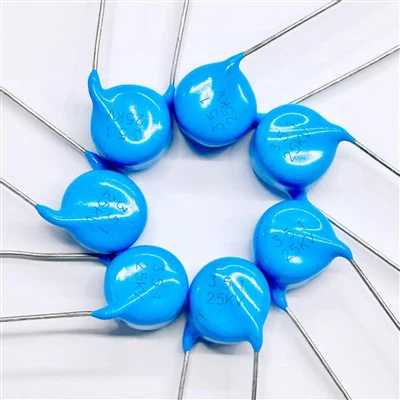
A high-voltage ceramic disc capacitor is a type of capacitor that utilizes ceramic material as its dielectric medium and is characterized by high voltage-withstanding capabilities-typically defined as having a rated voltage of 1 kV or higher. Its structure consists of a ceramic dielectric, internal electrodes, and external electrodes; the internal electrode materials typically include silver, copper, or nickel, while the packaging forms are predominantly disc-shaped, plate-like, or tubular. The ceramic dielectric is typically fabricated from capacitor ceramics possessing a high dielectric constant-such as barium titanate or titanium dioxide-which are extruded or formed into tubes, discs, or plates.
High-voltage ceramic disc capacitors possess exceptional voltage-withstanding capabilities, with an operating voltage range typically spanning from 1 kV to 100 kV. This class of capacitors is characterized by low dielectric loss and excellent high-frequency performance, featuring minimal energy dissipation and low equivalent series resistance, making them ideally suited for use in high-frequency circuits. In terms of temperature stability, Class I ceramics (such as C0G/NP0 materials) exhibit highly stable capacitance values; conversely, Class II ceramics (such as X7R/Y5V materials) demonstrate capacitance values that vary significantly with temperature fluctuations, yet offer a high capacitance-to-volume ratio. By employing a multilayer ceramic structure, high-voltage ceramic capacitors are able to achieve high capacitance values within a compact physical footprint. Based on voltage ratings, ceramic capacitors can be broadly categorized into high-voltage, medium-voltage, and low-voltage types.