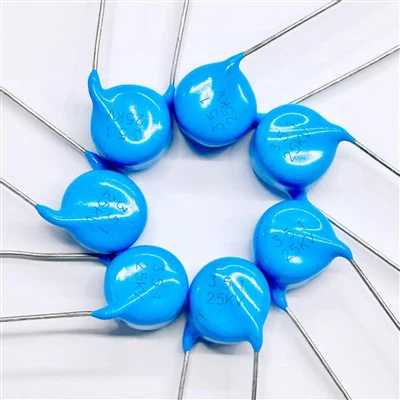
High-voltage capacitor ceramics serve as the critical dielectric material for manufacturing high-voltage ceramic capacitors. These capacitors utilize a ceramic dielectric and are characterized by their high voltage-withstanding capabilities (typically ≥1 kV). Structurally, they consist of a ceramic dielectric, internal electrodes, and external electrodes; their packaging forms are predominantly disc-shaped, plate-shaped, or tubular. They are widely applied across various sectors, including power systems, laser power supplies, color televisions, electron microscopes, photocopiers, office automation equipment, aerospace, missile technology, and marine navigation systems.
The primary ceramic material systems employed include barium titanate-based and strontium titanate-based compositions. Barium titanate-based materials exhibit a high dielectric constant but incur significant AC losses; conversely, strontium titanate-based materials possess a lower dielectric constant but offer superior dielectric strength and minimal AC losses. Lead-free systems primarily rely on BaTiO3 and SrTiO3 dielectric materials; within barium titanate-based systems, the incorporation of appropriate amounts of additives-such as SrTiO3 or CaTiO3-can effectively enhance dielectric performance. Current industry trends focus on improving dielectric strength through material innovation (e.g., zirconium-doped barium titanate) and overcoming capacitance limitations through structural optimization (e.g., three-dimensional stacked MLCCs).